
Extended Swarming A Bio-Inspired Design for Human Control over Robot Swarms
Abstract:
Robot swarms are composed of locally interacting units that operate without central control, resulting in high scalability, robustness against failures, and flexibility. This makes them particularly suitable for scenarios in which a large, challenging, and dynamic environment must be covered simultaneously, such as search and rescue operations. A key challenge in swarm robotics is enabling a single human operator to control and understand a large swarm without becoming overwhelmed by its complexity, while preserving the swarm's decentralised benefits.
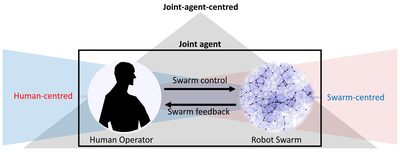
Most existing work in Human–Swarm Interaction (HSI) has focused either on the technical aspects of swarm control or on human factors. Despite substantial progress in both swarm robotics and human factors research, relatively little work has explicitly pursued an integrated perspective that considers how human cognition and the swarm's distributed nature should be effectively combined. To address this shortcoming, this thesis adopts a joint-agent perspective that considers the human and the swarm as parts of the same intelligent, scalable, robust, and flexible agent. More specifically, this thesis (1) presents the first detailed taxonomy focusing on HSI in the context of the swarm's distributed nature; (2) formulates Extended Swarming (ES) as a bio-inspired, integrated design approach to HSI; (3) develops and analyses agent programs for ES; and (4) investigates, through a user study, the sense of agency and the sense of ownership over swarm bodies.